

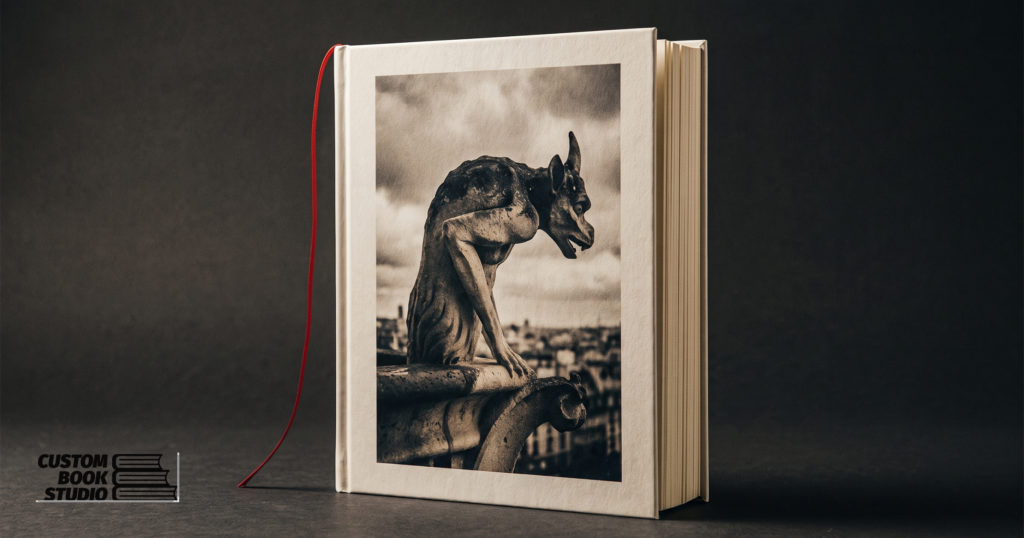
Some books are photographs with captions. Some are histories with pictures. Watchers in Stone tried to be both at once — fifty gargoyles and grotesques from the great cathedrals, each reimagined in raw cast concrete, each given a full-page portrait and a page of real history to stand on. This is a note on how the interior was built, and why a book like that lives or dies on a single, repeatable page.
A photography book and a history book
The structure is simple and never changes. Turn to any creature and you get a spread: on the left, a full-bleed plate — the beast alone, filling the page edge to edge, the way a photography book presents its subject. On the right, the history — where it sits, who carved it, when, and what it meant — set as a proper essay, the way a history book earns your trust.
That pairing is the whole idea. The photograph makes you stop; the history makes you stay. One page is atmosphere, the other is evidence, and the reader crosses the gutter between them fifty times without ever being told the rule.
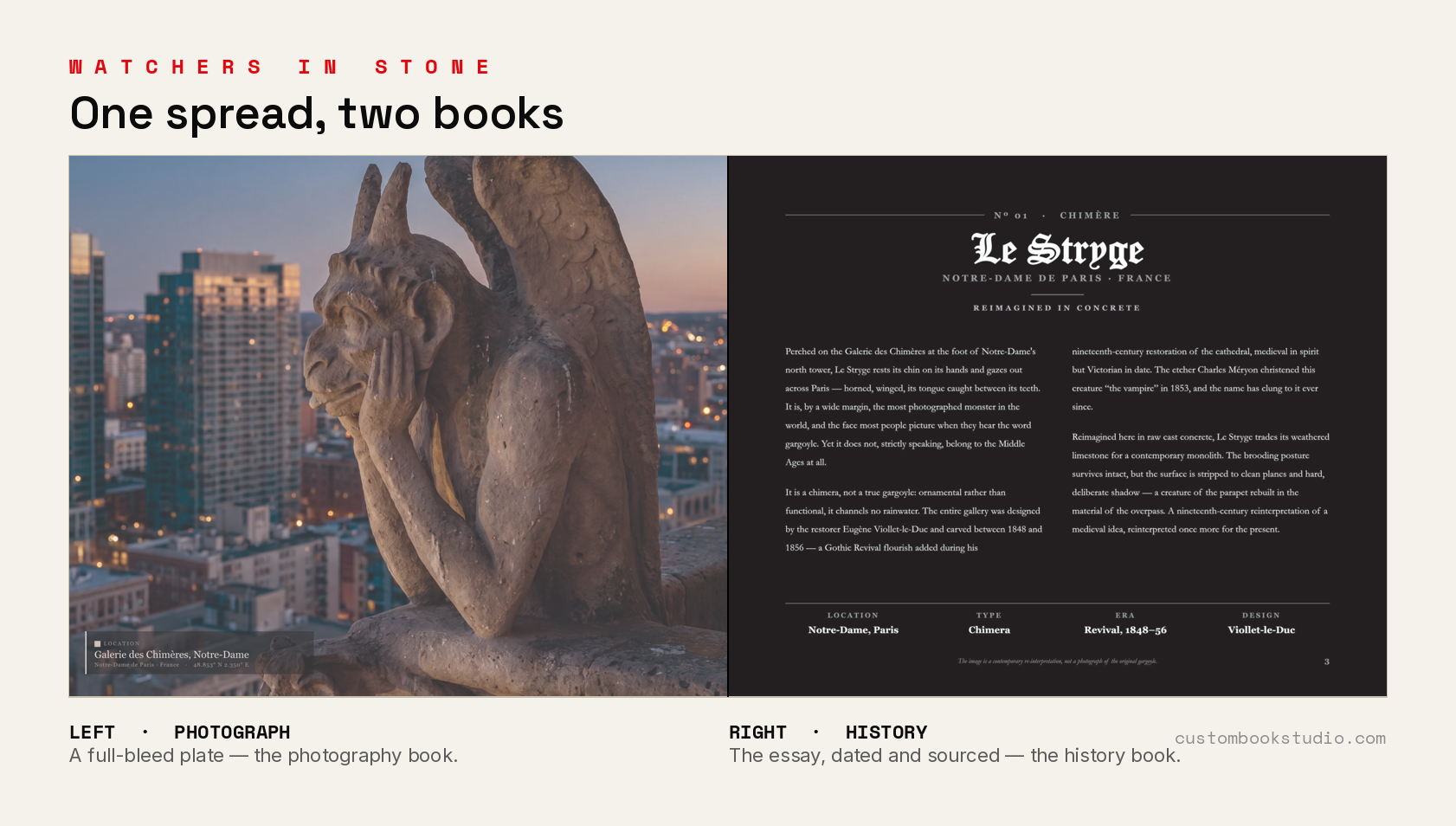
One page, built to survive fifty repetitions
A repeating page is unforgiving. If the frame is even slightly loose, fifty repetitions turn it into fifty small inconsistencies, and the book stops feeling like a book. So the history page was designed once, as a strict hierarchy of headings and subtexts, and then held to exactly — every recto uses the same eight parts, in the same places, at the same sizes.
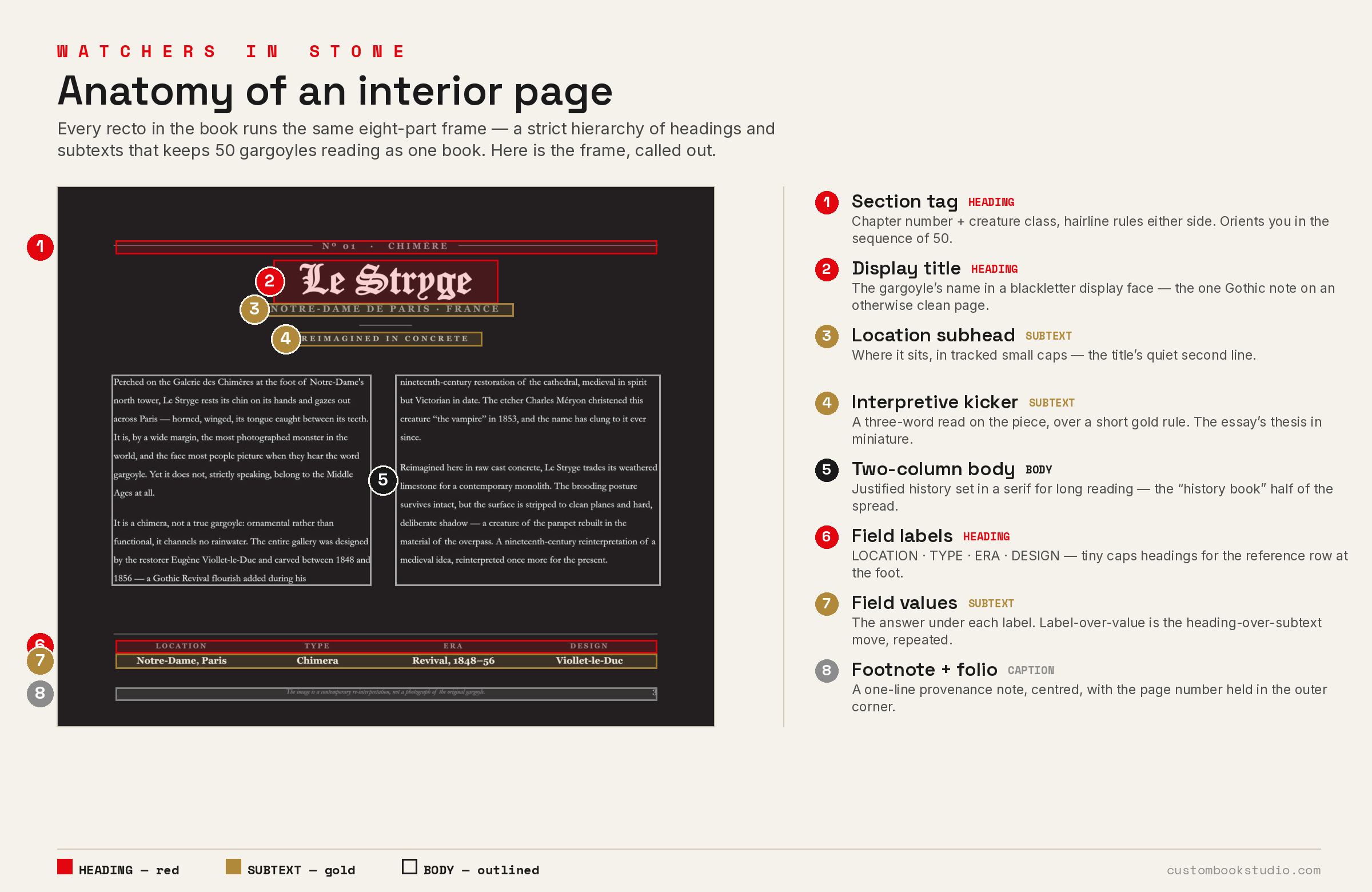
Read top to bottom, it is a chain of heading-and-subtext pairs. A small section tag (the creature’s number and class) orients you. The display title — the gargoyle’s name, set in a single blackletter face — is the one Gothic note on an otherwise clean page; directly beneath it, a quiet location subhead in tracked small caps, then a three-word interpretive kicker over a short gold rule. Below that, the two-column body carries the reading, justified and set in a serif built for long text — this is the history-book half doing its work.
The foot of the page repeats the same move at a smaller scale: a row of tiny-caps field labels — location, type, era, design — with their values set right underneath. Label over value is just heading over subtext one more time. A single-line footnote and the page number close it out. Nothing floats; everything has a job and a place.
Read the whole interior
Here is the finished interior in full — all 102 pages, exactly as they print. Page through it and watch the frame hold: the photograph, then the history, then the next creature, fifty times over.
All 102 interior pages of the finished book — full-bleed photography facing its history. Use the arrows or your keyboard’s ← → keys.
How it was made
The portraits are contemporary re-interpretations — the creatures rebuilt in cast concrete rather than weathered limestone, which is why every plate carries a quiet footnote saying so. The history pages are typeset from the record. Holding the two together is the job of the page frame above, and of the binding: Watchers in Stone is a smythe-sewn lay-flat hardcover, printed in signatures and sewn, so a full-bleed plate can run right up to the spine without a face disappearing into the gutter. That single binding choice is what lets a photography book and a history book share one object.
You can build a book on this kind of frame yourself with our AI Book Designer — it writes, illustrates, and lays out every page, and you approve each one — or bring us a bespoke project and we will design and print it with you. Either way, get in touch and we will talk it through like real people.
Turn it over in 3D
And here is the whole thing as an object. This is the exact 3D proof we build for sign-off before a single sheet is printed — drag to turn the book, scroll to zoom, and use the controls to open the covers, lift the endsheets, and slip the dust jacket on and off.
A smythe-sewn lay-flat hardcover with a printed dust jacket, cased in the gargoyle wrap and lined with printed endpapers — the real proof, rendered from the real art. Drag to rotate, scroll to zoom, and open it with the on-screen controls.