
On July 20 a federal judge gave final approval to the largest copyright settlement in United States history. Anthropic, the company behind the Claude AI models, will pay at least $1.5 billion to authors whose books it pirated to train its software. For anyone who writes and publishes their own work, it is worth knowing exactly what the court decided — and, just as important, what it did not.
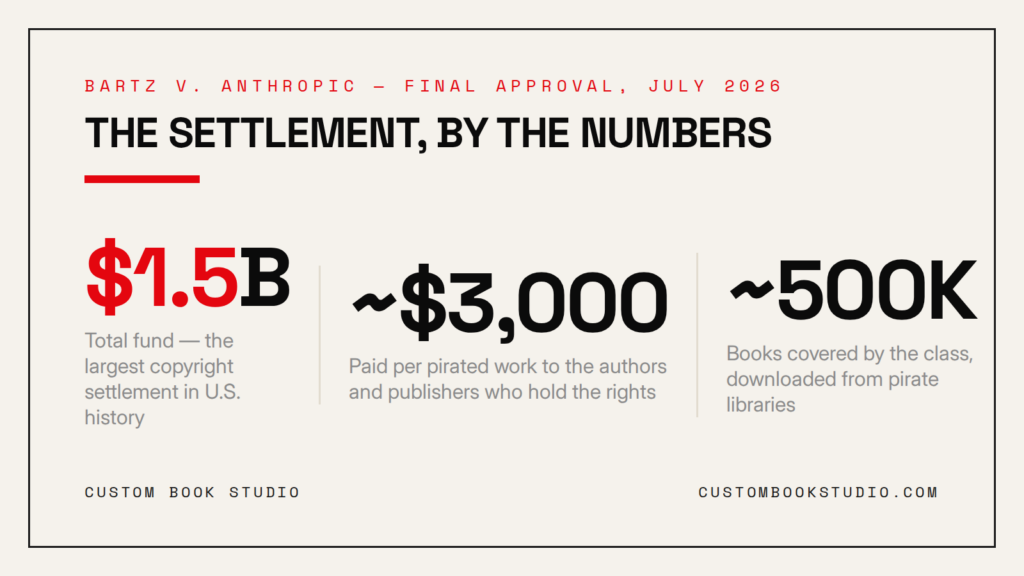
The case, Bartz v. Anthropic, was brought in 2024 by a group of authors who found their books among roughly 500,000 titles the company had pulled from pirate libraries. As Reuters reported, the payout works out to about $3,000 per work, shared between the authors and the publishers who hold the rights.
What the court actually decided
The ruling drew a sharp line, and it is the part self-published authors should hold on to. In an earlier decision, U.S. District Judge William Alsup found that training an AI model on books a company had lawfully bought counted as fair use. What crossed the line was how Anthropic got many of the books in the first place: it downloaded pirated copies from sites such as Library Genesis and stored them permanently. Buying a book and learning from it — allowed. Grabbing a pirated file and keeping a library of them — infringement.
Judge Alsup retired at the end of 2025, and Judge Araceli Martínez-Olguín took over and signed off on the deal, calling it “meaningful relief” for the class given how long, costly and uncertain a trial would have been. Publishers Weekly reported that the large majority of eligible rights holders opted in rather than go it alone.
Why this matters if you publish your own books
It is easy to read a headline like this as a story about two tech giants. It is not. The people being paid are authors — the same independent writers, illustrators and small publishers we print for every day. The settlement is a plain statement that a finished book is property, and that the person who made it holds rights worth defending, even against a company valued in the billions.
The practical lesson is old-fashioned and still true: your copyright is only as strong as your ability to prove it. In the United States you own the copyright the moment you fix a work on the page, but registering your book with the U.S. Copyright Office is what lets you enforce that right and claim the kind of damages that made this case possible in the first place. If you are putting out a book, register it.
What the settlement does not settle
One caution. This was a single settlement in a single district, and Anthropic chose to pay rather than appeal — so it sets no binding precedent. As TechCrunch noted, the larger question of how AI may use copyrighted work is still being fought in separate cases against Google, Meta, OpenAI and others. Expect the ground to keep shifting for a while yet.
Your book, your name on it
At Custom Book Studio we sit on the honest side of that line. Our AI Book Designer helps you shape a book, but the words and the art are yours, the print files are yours, and the finished object carries your name — not ours, and not a data set’s. When the manuscript is ready, we make it real: hardcover, softcover, coil and saddle-stitched short runs on real paper, printed to sell.
If this settlement is a reminder of anything, it is that a book is worth protecting. Write it, register it, and put it into print.
Where we get our news: for printing, paper and book manufacturing we follow PrintCAN; for the indie-author beat, The Alliance of Independent Authors, Jane Friedman and The Passive Voice.