
Every printed book, whatever the genre, is made of the same raw material: paper. So when the printing-industry press starts running paper stories two weeks in a row, it’s worth paying attention. This month the Canadian print-news site PrintCAN reported two of them — and together they point the same direction: the paper supply is getting tighter.
What’s happening
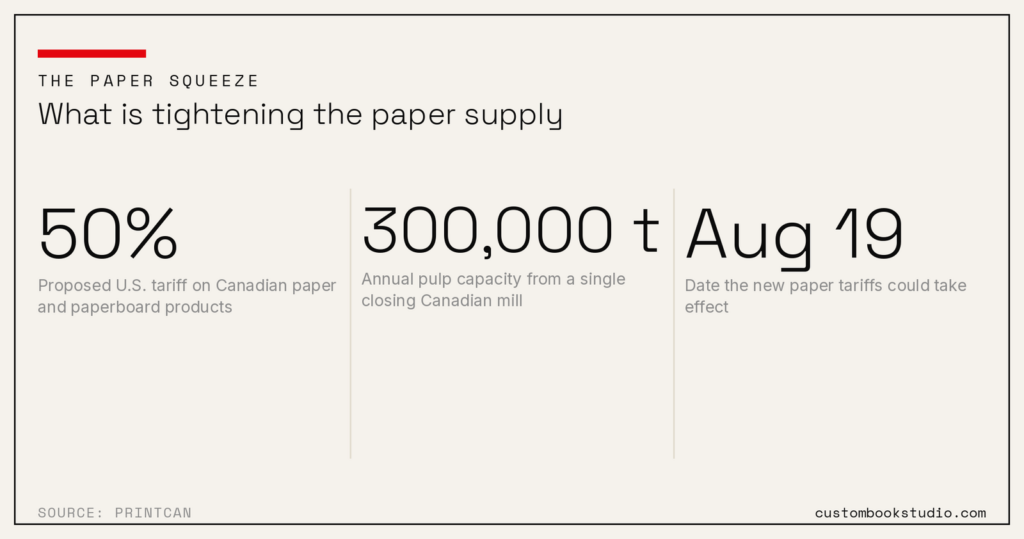
First, tariffs. As PrintCAN reported, a set of proclamations out of Washington would put a 50% tariff on a broad list of Canadian paper and paperboard products — graphic papers, coated stock, envelopes, cartons — potentially from August 19, and applying whether or not the goods qualify under the USMCA. How hard that lands on printers is, in PrintCAN’s words, “any one’s guess,” but a 50% line item on a core material is not nothing.
Second, supply. In a separate report, PrintCAN covered another round of pulp-mill closures — including a Canadian mill shedding roughly 300,000 tonnes of annual pulp capacity and about 300 jobs, part of a multi-year trend of shutdowns across the industry. Less pulp made, more tariff on what crosses the border: both push the same way on price and lead time.
Why it matters for your book
Paper is one of the largest single costs in a printed book, so anything that moves the paper market eventually shows up in what a print run costs and how long it takes. For a big traditional publisher printing tens of thousands of copies, that means hedging contracts and warehouses. For an independent author, it means something simpler: the old model of ordering a garage-load of books up front looks riskier when paper prices are moving.
Short runs are the hedge
This is exactly where short-run and print-on-demand shine. When you print what you need, when you need it, you’re never sitting on a pallet of unsold stock bought at last month’s paper price — and you’re never out of print either. At Custom Book Studio we watch the paper market so you don’t have to: the AI Book Designer gets your book print-ready, and you order in the quantities that make sense. Choose your binding and paper, approve a 3D proof, and print on your terms.
Sources: reporting by PrintCAN — paper tariffs and pulp-mill closures.