

If you still think of self-publishing as a niche, the 2026 numbers will change your mind. More books are being made, by more people, than at any point in history — and almost all of that growth is coming from independent authors.
The headline figures
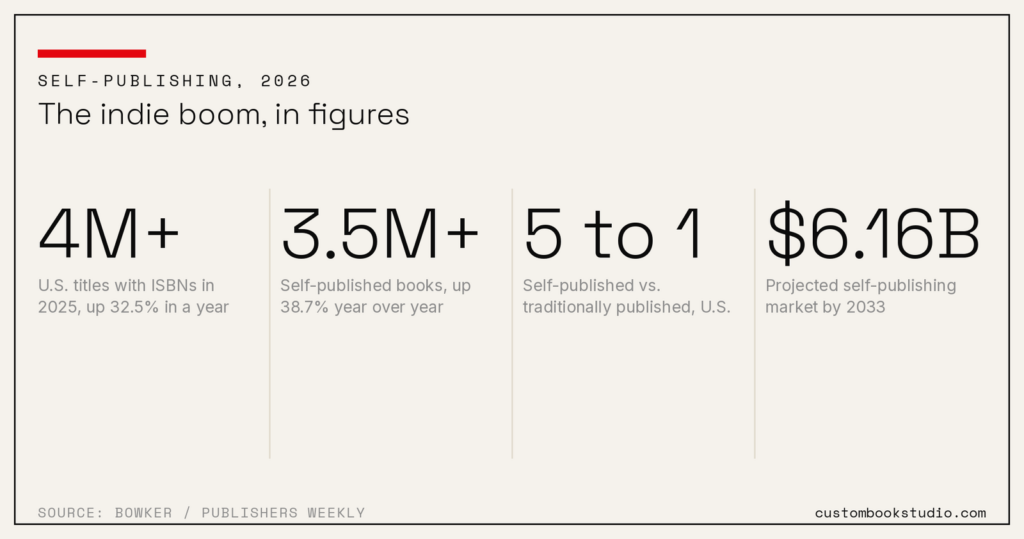
The number of U.S. titles registered with an ISBN topped four million in 2025 — a 32.5% jump in a single year, according to Bowker data reported by Publishers Weekly. The self-published slice drove it: self-published print and e-books rose 38.7% to more than 3.5 million. Zoom out and, as the Publishing by the Numbers roundup notes, self-published books now outnumber traditionally published ones in the U.S. by better than five to one, with the self-publishing market projected to reach $6.16 billion by 2033.
What the numbers are really saying
The gatekeepers didn’t disappear — authors simply routed around them. That’s a good-news story about access: a first-time novelist, a retiree writing a family history, a small business making a branded book can now reach print without a publishing contract. The book manufacturing world has noticed; the industry’s own State of the Book Industry reporting on PrintCAN puts print-on-demand and shifting publisher demand near the centre of where the business is heading.
More titles, smaller runs
Here’s the part that matters for how books actually get made: four million titles does not mean four million big print runs. Most of these books sell in the tens or hundreds, not the thousands — which is precisely the shape short-run and print-on-demand printing is built for. You don’t need a warehouse; you need a great file and a printer who’ll make ten copies as happily as ten thousand. That’s the whole idea behind the AI Book Designer: get your book print-ready, then print what you need. Start your book.
Sources: Publishers Weekly / Bowker, Publishing by the Numbers, and PrintCAN.