
Most people picture self-publishing as a mountain of software, file specs and guesswork. At Custom Book Studio it’s closer to a conversation: you bring the idea, and the studio — a mix of AI and working printers — takes it from a one-line brief to a bound, print-ready book you can hold. To show how, here is the whole journey of one of our demo books, Dash — The Brave Little Raptor, from first sentence to a 3D proof you can spin around at the bottom of this page.
It starts with one idea
Every book begins with a brief — a sentence or two about the story you want. Dash’s was simple: a young velociraptor who thinks the whole world is his friend, until some bigger dinosaurs prove him wrong — and he learns to choose his friends wisely and stand up for himself without fighting. That’s it. From that seed, the studio proposes a cast, a page count and a shape (Dash is a 32-page, 8×8 inch hardcover), and you’re off.
Meet the cast
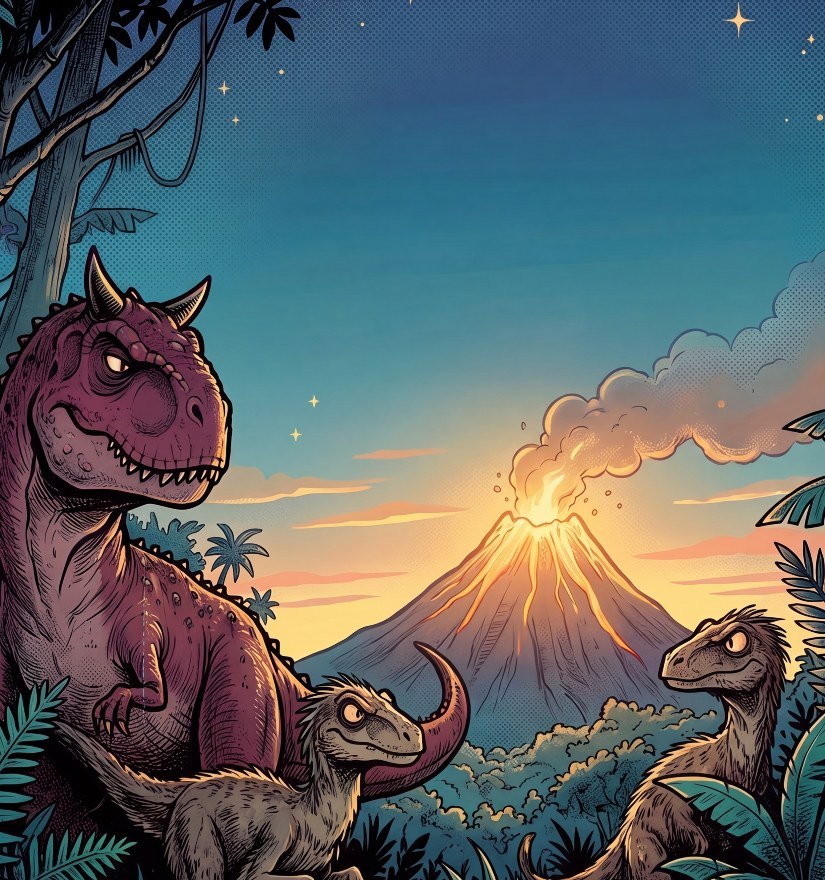
Before a single page is drawn, the studio designs the characters and locks them — a reference sheet for each one so they look consistent on every page. Dash got a brave little green raptor with a rust-orange crest; his world got Bruto, a maroon Carnotaurus with a mean streak, Bruto’s two scruffy sidekicks, and Master Fern, the wise mentor. Locking the cast first is what keeps Dash recognisably Dash — and Bruto recognisably Bruto — across all 32 pages.
Writing the story
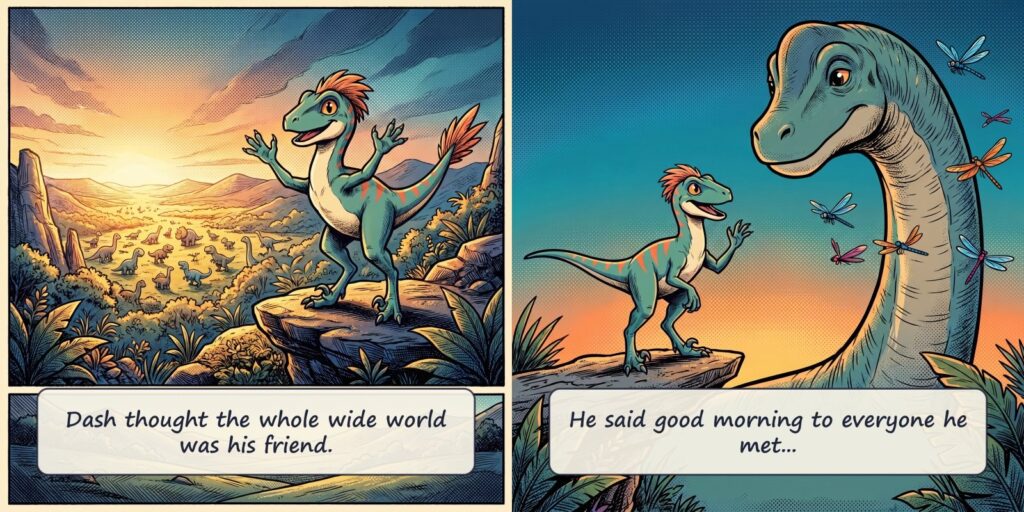
With the cast set, the studio authors the whole book — every page’s scene and words — from your brief. You stay in the driver’s seat: read it, tweak it, approve it. Dash opens the way the best picture books do, quietly:
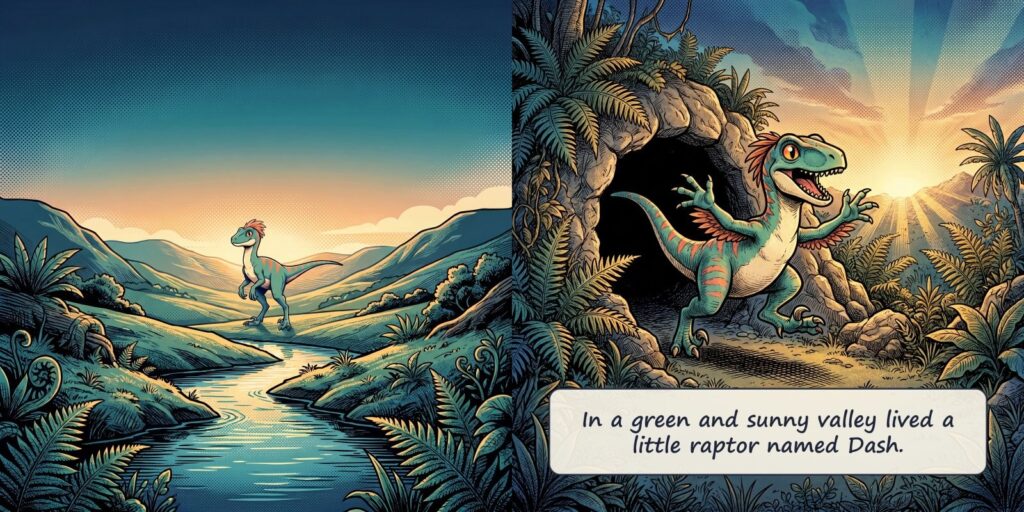
From there the story does its gentle work — Dash greets everyone as a friend, meets dinosaurs who aren’t, and grows braver and wiser by the last page.
Illustrating every page
Each page is then illustrated in a single, consistent art style — here a bold comic look with deep skies and warm light — using the locked character references so the cast stays on-model. The words are placed into clean, legible plates over the art, spread by spread.
Cover, casewrap and endpapers
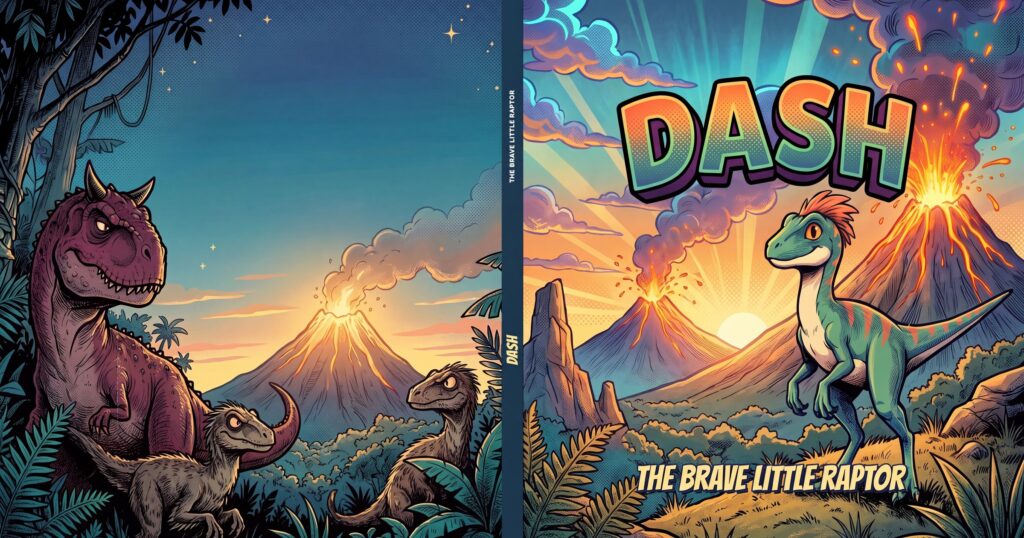
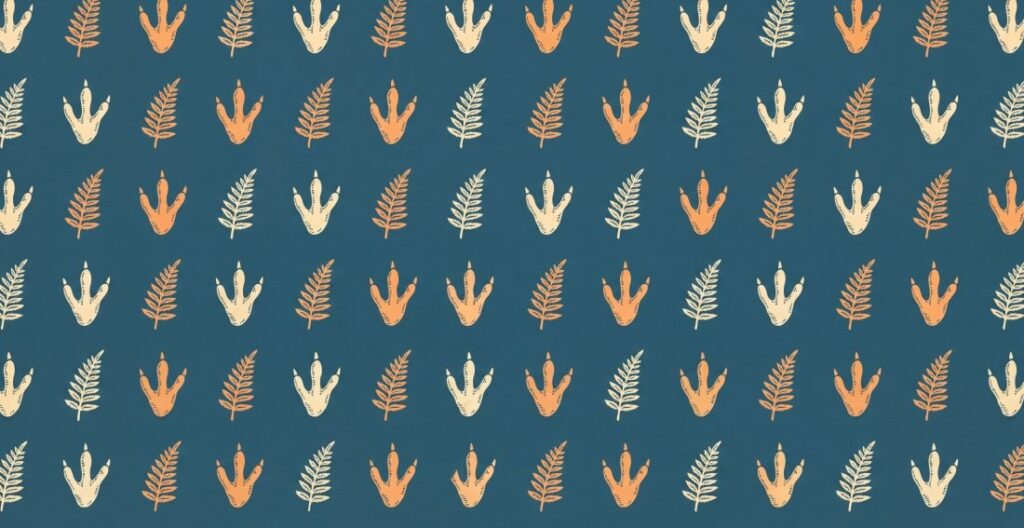
A hardcover is more than a front cover. The studio builds the full casewrap — one continuous wraparound illustration across back, spine and front, the one you can see at the top of this page — laid out to real print geometry so trim, bleed and safe margins are handled before anything is cut and cased. Even the endpapers, the sheets inside the covers, get their own art: a quiet repeating pattern of raptor footprints and ferns that ties the whole object together.
The proof you can actually hold — in 3D
Here’s the part that makes it real. Before anything is printed, the whole book becomes an interactive 3D proof: the actual cover, casewrap, endpapers and interior, textured onto a real hardcover you can spin, open and read through in your browser. It’s exactly what you see when it’s time to approve a book — drag to rotate, scroll to zoom, open the covers, and page through.
When it looks right, one button approves it and the book moves to production. If something’s off, you say so and it goes back a step — no risky print run, no surprises.
Make your own
That’s the whole path: an idea, a cast, a story, the art, and a 3D proof — then a real, bound book. If you’ve got a story in you, you can start one the same way Dash started, with a single sentence. Begin in the AI Book Designer, see how we print and bind, or just start your book.