
AI book cover design crossed a line in 2026: it went mainstream. A crop of AI cover generators now promises a finished, genre-ready cover in minutes, and plenty of indie authors are using them. The tools are genuinely good. But a cover was never really a picture — it’s a marketing decision that happens to look like one, and that part hasn’t been automated away.
On a recent episode of the ALLi “Self-Publishing” podcast, Pablo Yáñez — a book-cover photographer of fifteen years before he built an AI cover tool — put it plainly: AI can help you make a marketable cover, but genre conventions matter more than most writers realise, and the author still has to direct the design rather than roll the dice on a prompt. That is exactly how we think about covers at Custom Book Studio.
A cover is a genre signal first
Before a reader takes in a single detail, your cover has already told them what kind of book this is. Colour, type, and composition do the work in a fraction of a second. Get the signal right and the right readers lean in; get it wrong — a horror novel that reads as a cosy mystery — and the best artwork in the world won’t save the sale.
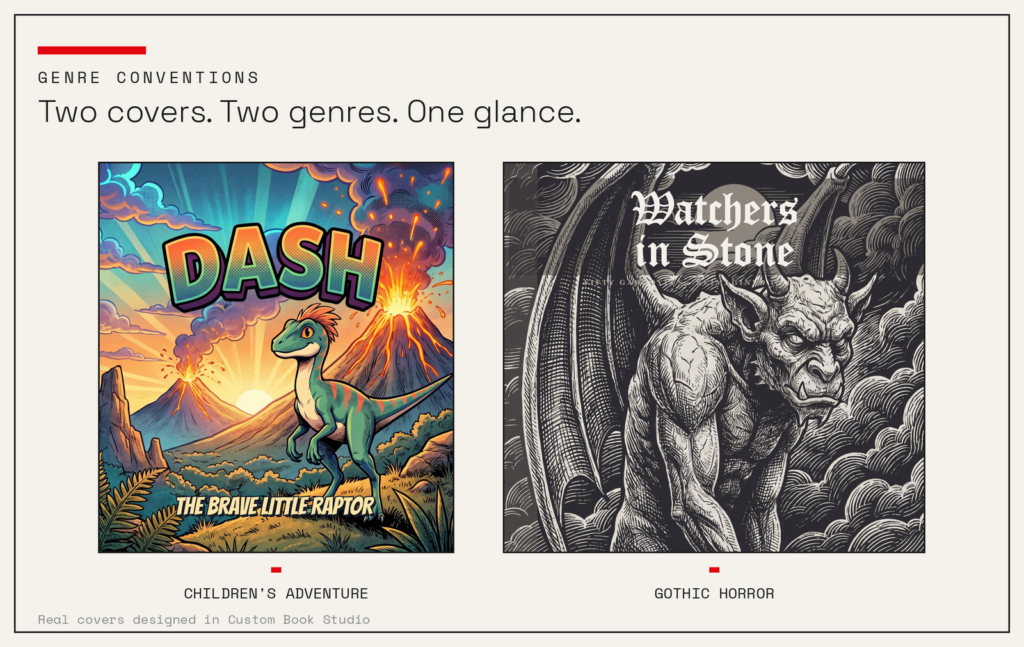
That’s the discipline behind a good cover, AI-made or not: it has to honour the visual language of its shelf. The 2026 cover-design conventions — bold type, clear focal points, genre-true palettes — exist because they work, and they’re the guardrails a raw image prompt tends to ignore.
The thumbnail test
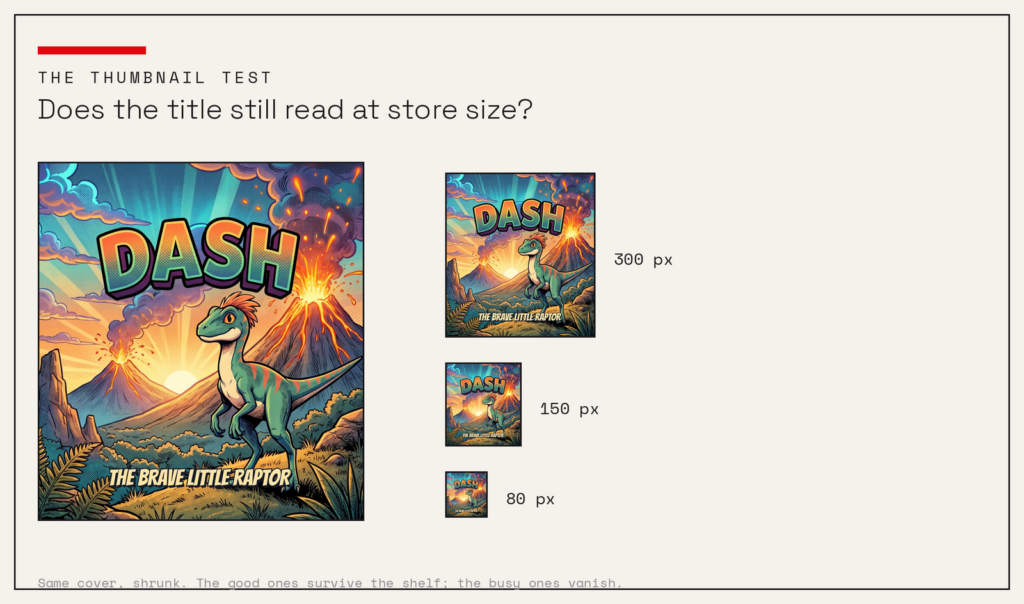
Most books today are first seen the size of a postage stamp — a thumbnail in a store grid or a social feed. A cover that’s gorgeous at full size but a muddy smudge at 150 pixels has already lost. So the real test isn’t “is it beautiful on my screen?” It’s “does the title still read, and does the genre still land, when it’s tiny?”
Direct the design, don’t roll the dice
The difference between a cover that works and a lucky screenshot is control. A prompt-and-pray approach gives you a surprise; direction gives you a cover — the right title treatment, a focal point that reads small, a palette chosen for the genre, and space left for the words. AI is the fastest way yet to explore options, but somebody still has to make the calls.
And then it still has to print
Here is the part the generators quietly skip. A screen image is not a print file. A real cover needs the title spelled correctly and set as crisp type, the right trim and bleed, a spine sized to the actual page count, and a proof you can approve before anything is bound. That last mile is the whole job at Custom Book Studio: the AI Book Designer helps you direct a genre-true cover, sets the text cleanly, and hands you a genuinely print-ready file — and it stays yours.
Choose your binding and paper, approve a 3D proof, and put your cover into print.
Where we get our news: for printing, paper and book manufacturing we follow PrintCAN; for the indie-author beat, The Alliance of Independent Authors, Jane Friedman and The Passive Voice.