
This is the second entry in our book types series — one binding at a time, what it is, how it is made, and what we would print with it. Last time we covered coil and wire. Today it is the humblest binding on the floor and, page for page, often the smartest: saddle stitching.
What saddle stitching actually is
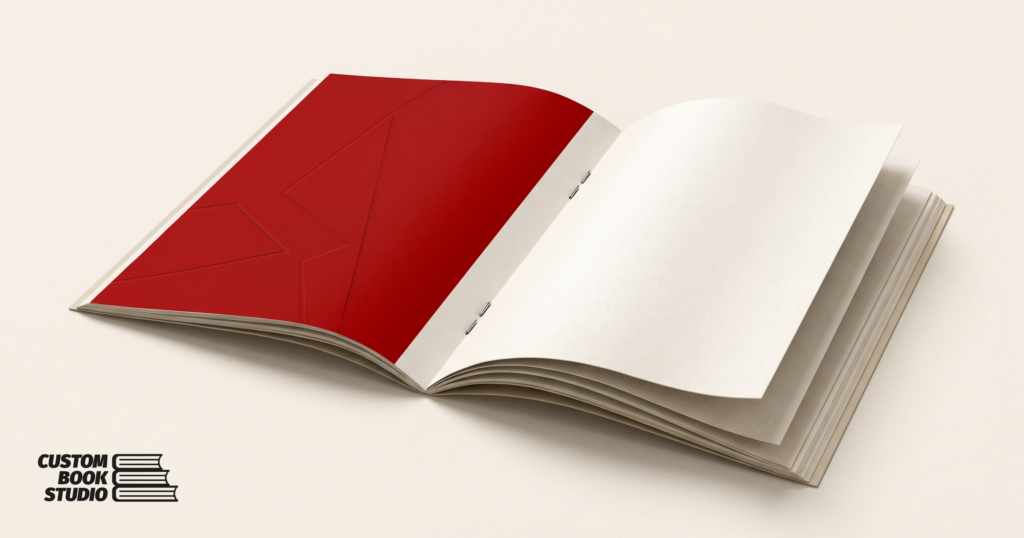
Despite the name, there is no stitching and no thread. “Saddle” refers to the saddle-shaped bar the folded sheets straddle while a machine drives two wire staples through the spine. That is the whole binding: printed sheets, folded, nested one inside another, and stapled on the fold. It is the same construction as most magazines and event programs you have ever held.
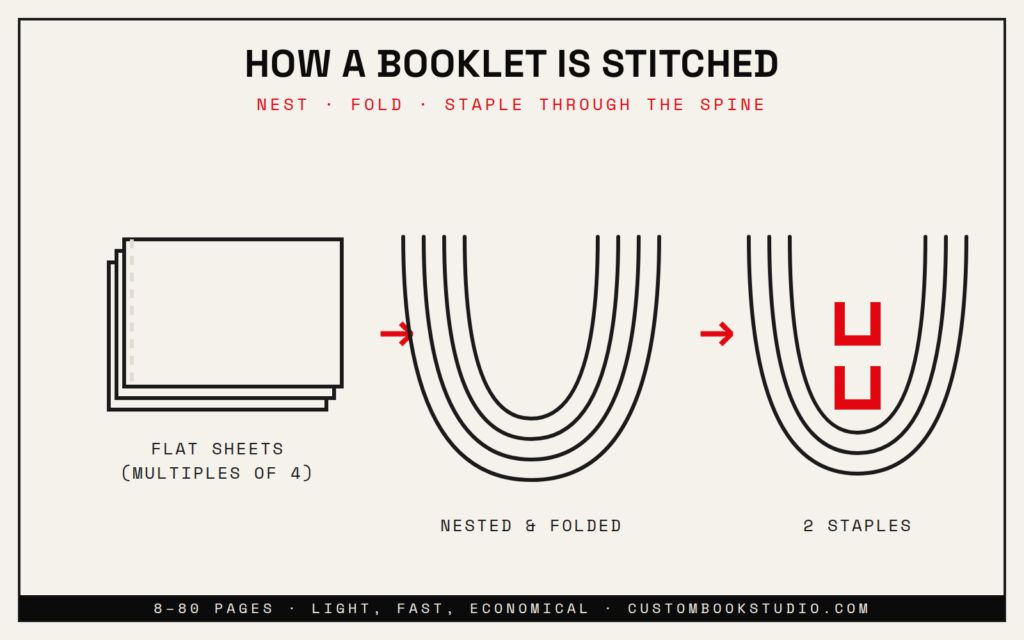
Because every sheet is folded and nested, a saddle-stitched book is always built in multiples of four pages — one folded sheet is four pages. It works beautifully from about 8 up to 80 pages. Past that the booklet gets too thick to fold cleanly, and the binding to reach for becomes perfect binding or coil.
What it does well
Saddle stitching wins on three things at once: it is light, it is fast, and it is the most economical binding we offer at low page counts. There is no spine to glue or sew and no cover to case, so both the material cost and the production time drop. A stapled booklet also opens close to flat and takes a self-cover — the cover printed on the same stock as the inside — which keeps short runs especially cheap.
It also handles a full-bleed spread more gracefully than a glued spine. Because the centre pages fold rather than butt against glue, an image can cross the centrefold with only a small, predictable shift.
The honest trade-offs
- Page count: 8 to 80 pages, always a multiple of four. It is not a binding for a novel.
- No printed spine: a stapled booklet has a folded edge, not a flat spine, so there is nowhere to print a title for a shelf.
- Creep: as pages nest, the innermost sheets push out slightly and are trimmed a hair narrower. On a thick booklet we allow for it in the layout so nothing important drifts off the page.
What we would print saddle-stitched
Magazines and newsletters, event and theatre programs, product catalogs, chapbooks and zines, short manuals and guides, order of service booklets, comic issues, lookbooks. Anything under about 80 pages that needs to look clean, mail light, and be produced in a hurry or on a budget is a saddle-stitch candidate.
Designing for the staple
The main production note is the same creep we mentioned: keep page numbers and anything critical clear of the outer trim on inner spreads, and treat the centrefold as a genuine seam. If you build your booklet in the AI Book Designer, the page count is kept to a valid multiple of four and the safe margins are handled for you.
Saddle stitching is a standard binding you can start today — see book printing or go straight to start your book. Not sure whether your project wants staples or a glued spine? Tell us the page count and how it will be used and we will point you the right way.
Next in the book types series: softcover, perfect bound — the trade paperback, and the glued spine that makes it.