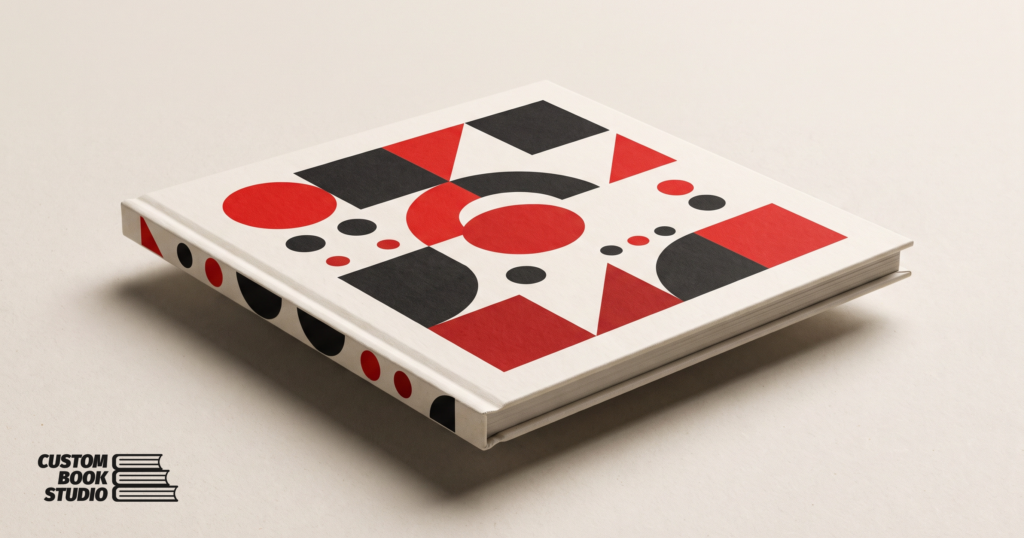
This is the fourth entry in our book types series — one binding at a time, what it is, how it is made, and what we would print with it. We have worked up from staples to glue. This is the top of the range and the binding we build when a book is meant to last: hardcover, Smythe sewn.
What Smythe sewing is
Instead of gluing single leaves, a Smythe-sewn book is printed in signatures — folded groups of 8 or 16 pages. Those signatures are stacked and physically sewn together with thread through their folds, then the sewn block is glued along the spine, rounded, and cased into hard boards wrapped in cloth, printed paper, leather or other material. Thread does the structural work; the boards do the protecting.
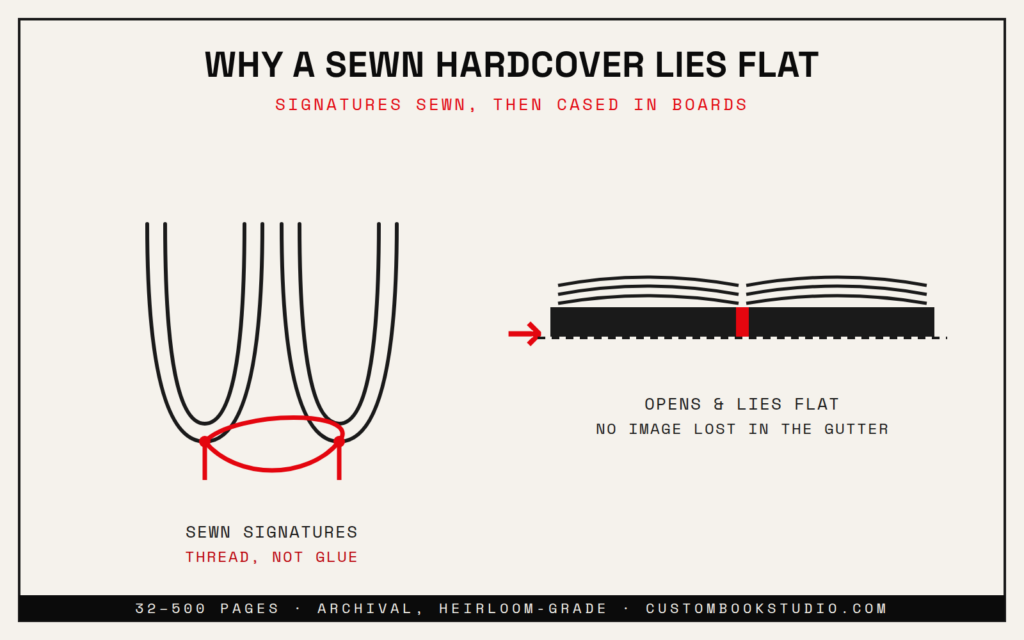
That thread is why a sewn book behaves so differently from a glued one. The signatures pivot freely on the stitching, so the book opens and lies completely flat — and because nothing is clamped in a bed of glue, an image can cross the centre of a spread with no loss in the gutter.
What it does well
A Smythe-sewn hardcover is archival. Sewn bindings outlast glued ones by decades — there is no glue line to grow brittle and shed pages — which is why libraries, monographs and heirloom books are sewn. It is also the only binding in our range that is genuinely lay-flat at any page count from about 32 to 500 pages, so a photo book or cookbook stays open on the table by itself. And the case is where the craft shows: image-wrap, linen, leather, Arrestox, Fiscagoma or exposed board, with head and tail bands and printed or foil-stamped spines.
The honest trade-offs
- Cost and time: sewing and casing are extra steps with extra materials, so a hardcover is the most expensive and slowest binding we make. For a working document or a giveaway it is overkill.
- Weight and bulk: boards make a heavier, thicker book — wonderful on a coffee table, less ideal if it has to mail cheaply in quantity.
- Page-count floor: you need enough signatures to sew and round a spine, so very thin projects belong in saddle stitch or coil.
What we would print as a sewn hardcover
Photography and art monographs, anniversary, legacy and family books, cookbooks that must stay open while you cook, children’s picture books, thesis and archival editions, premium catalogs and any book meant to be kept rather than consumed. If the words “heirloom,” “archival” or “lie flat” describe the goal, this is the binding.
Designing for a sewn hardcover
The good news for designers: because a sewn hardcover lies flat with no gutter loss, this is the one binding where a full-spread crossover image is safe. You still design a wrap that accounts for the board overhang and the spine width, both of which follow from your page count and paper — and both of which the AI Book Designer works out for you, case and all.
Hardcover is a standard option — see book printing or start your book. For special wraps, foil and slipcases, talk to us and we will spec it as custom work.
Last in the book types series: the ebook & epub — the one “binding” with no paper at all.