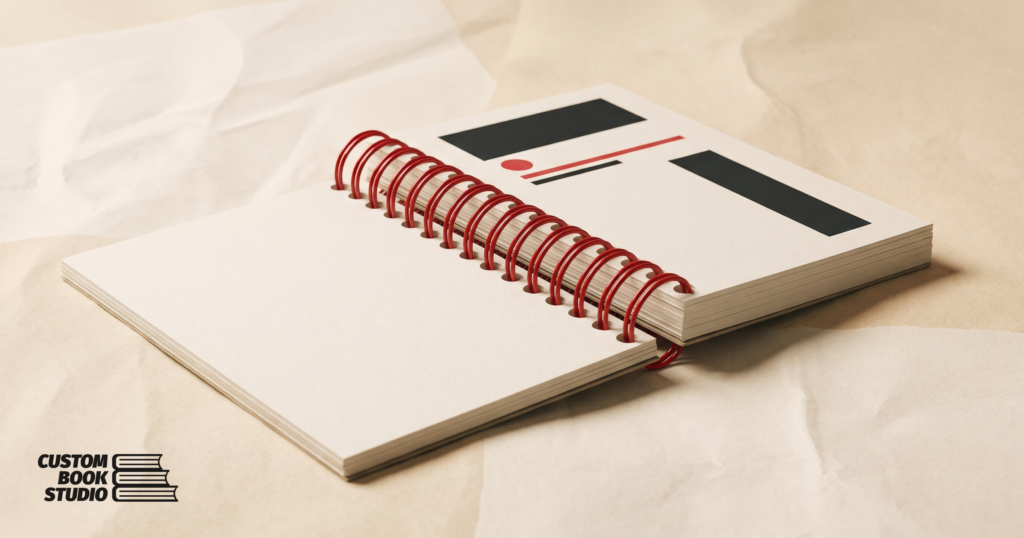
This is the first entry in our book types series — one binding at a time, what it is, what it does well, and what we’d print with it. We’re starting with the coil and wire family: plastic coil and double-loop wire. They look similar from across the room. Up close, on the press floor, they behave differently — and picking the right one is mostly about knowing how your book will be used.
Why lying flat matters
Every binding in this family shares one defining trait: the book opens a full 360 degrees and lies truly flat on the table. No cracked spine, no page curling back, no holding it open with one hand while you write with the other. The pages rotate freely around the binding, so a coil-bound book behaves less like a novel and more like a tool.
That is exactly why coil and wire are the working choice for anything people write in or work from: workbooks and course material, journals and planners, coloring books, lab and field notebooks, recipe books that stay open on the counter, and manuals that get used with both hands busy. If your book is meant to be filled in, folded back, or propped open for hours, this is the family to look at.
Two bindings, one family
Both bindings work the same way mechanically. We punch a row of holes along the binding edge of the cover and every page, then thread the binding through: no glue, no thread, no spine pressure. The difference is in what gets threaded.
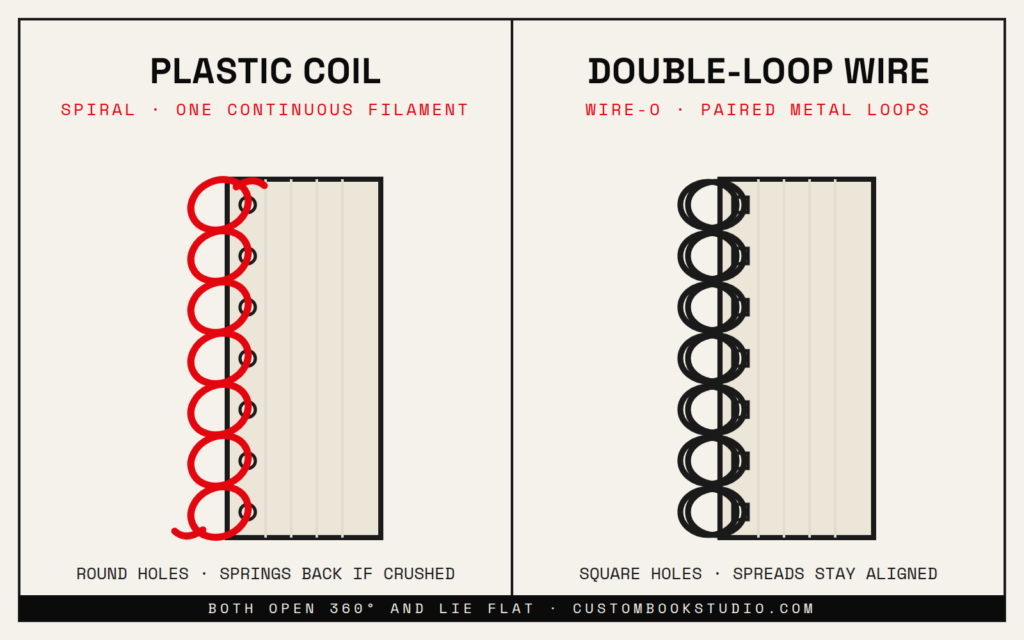
Plastic coil — often called spiral binding — is one continuous plastic filament wound through a row of round holes, then crimped at both ends. Double-loop wire — also sold as wire-o or twin-loop — is a preformed row of paired metal loops closed through square holes. One filament versus paired loops sounds like a small distinction. It drives every practical difference between them.
Plastic coil, up close
The coil is extruded PVC, so it has memory: sit on it, drop the book in a bag, bend it in half — it springs back to round. That resilience is why plastic coil owns the classroom and the kitchen. It shrugs off abuse that would leave a metal binding visibly kinked. It also comes in colors, so the binding can match or deliberately contrast the cover.
The trade-off is a small one: because the coil is a helix, each page steps up slightly as it wraps around, so facing pages sit a few millimetres offset from each other. For a workbook or a coloring book nobody will ever notice. For a spread where left and right pages must line up exactly, it can matter.
Double-loop wire, up close
Wire loops hold every page on the same axis, so spreads stay perfectly registered — a calendar grid or a panoramic photo runs across the gutter without a step. The metal finish also reads more formal: silver, black or bronzed wire on a portfolio or an annual report looks deliberate in a way plastic doesn’t.
The trade-off mirrors the coil’s: metal holds its shape until it doesn’t. A crushed wire loop stays crushed. Wire books ride in briefcases and sit on desks; they don’t love the bottom of a school bag.
The differences that decide it
- Resilience: plastic coil springs back after crushing; double-loop wire holds a dent. Kids and travel favour coil; desks and boardrooms favour wire.
- Page registration: the coil’s helix steps facing pages slightly; wire keeps spreads perfectly aligned.
- Look: coil is casual and comes in colors; wire is metal, formal, and photographs like office hardware in a good way.
- Cost: plastic coil is usually the more economical of the two on short runs.
- Both: open 360 degrees, fold back on themselves, lie dead flat, and take a wide range of page counts and paper weights.
What we’d print with each
Plastic coil: workbooks and classroom sets, coloring and activity books, journals that travel, field guides, shop and kitchen manuals, anything a child owns. Double-loop wire: planners and desk calendars, portfolios, reports and proposals, wine and tasting journals, spreads that must align. If you’re unsure, the honest question is: where will the book live, and how hard a life will it have?
Designing for the coil edge
One production note worth knowing before you lay out pages: the punched edge consumes real estate. Text and art need to keep clear of the hole line, so the inside margin on a coil or wire book runs a little wider than on a glued book. If you build your book in the AI Book Designer, the safe margins for the binding are handled for you — the layout keeps your content clear of the punch line automatically.
Plastic coil is our standard lie-flat binding and you can start one today — see book printing or go straight to start your book. If a project genuinely calls for double-loop wire, talk to us and we’ll quote it as custom work.
Next in the book types series: saddle stitching — the humble two-staple binding that punches far above its weight.