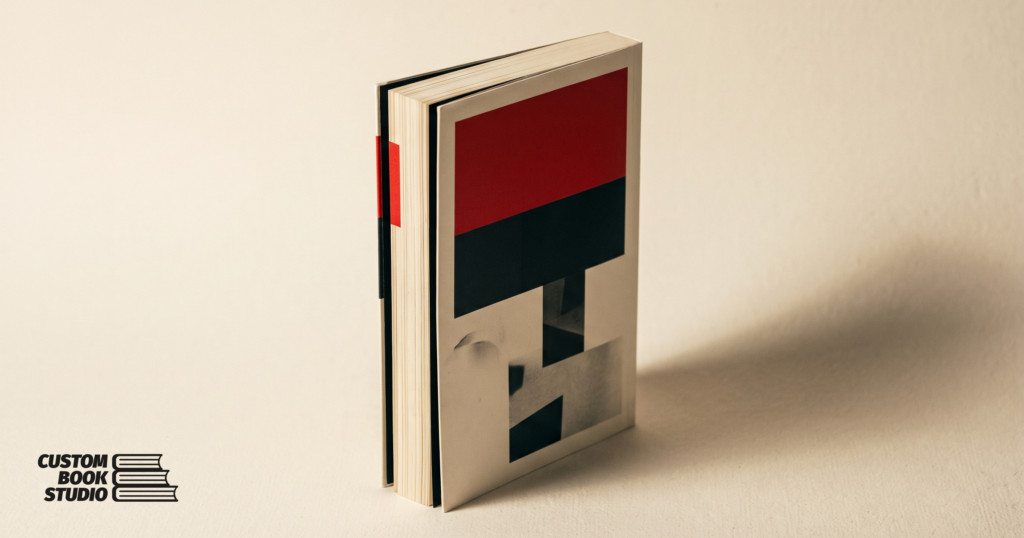
This is the third entry in our book types series — one binding at a time, what it is, how it is made, and what we would print with it. So far we have covered coil, wire and saddle stitching. Now the binding you picture when you picture a paperback: softcover, perfect bound.
What perfect binding is
A perfect-bound book is a stack of single leaves — not folded, nested signatures — whose spine edge is ground flat, coated in hot-melt glue, and wrapped in a heavier cover that has been scored so it creases cleanly at the spine. The result is the flat, printable spine and squared-off trade-paperback feel everyone recognises from a bookstore shelf.
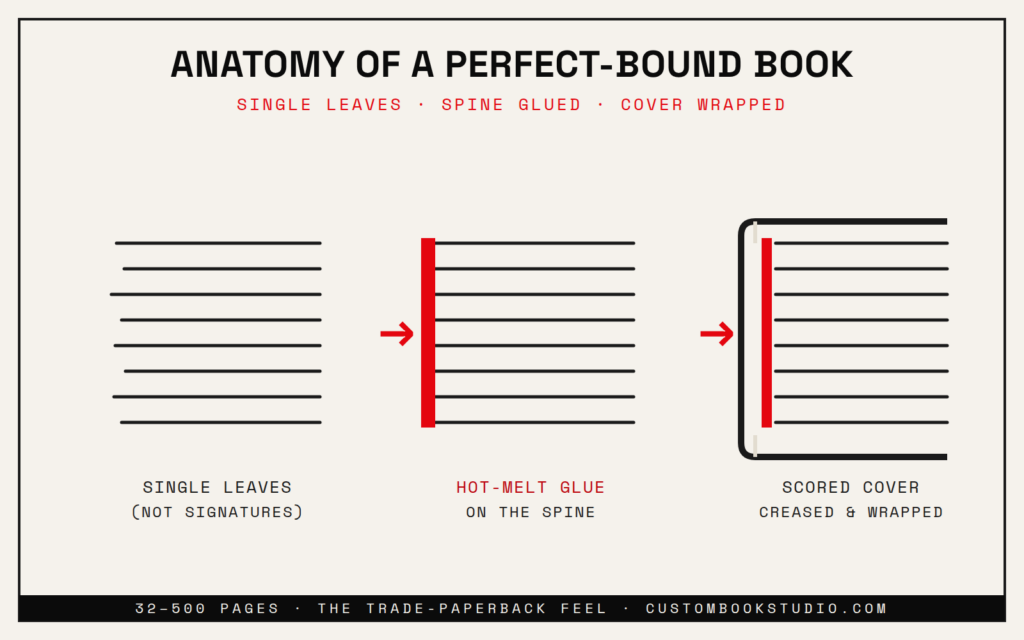
That flat spine is the whole point: it gives you a surface to print a title, so the book stands on a shelf and reads spine-out. It is the standard for novels and most trade non-fiction for exactly that reason.
What it does well
Perfect binding is the versatile middle of our range. It runs from about 32 to 500 pages, costs far less than a sewn hardcover, and still looks unmistakably like “a book.” The cover stock takes a matte or gloss laminate, soft-touch finishes, spot treatments — so a paperback can feel anywhere from airport-thriller to art-gallery. For most catalogs, magazines with a real spine, and any novel or memoir, it is the natural choice.
The honest trade-offs
- It does not lie flat. The glued spine holds the book closed, so a perfect-bound book resists staying open on a table. For a cookbook, workbook or music score you actually want coil or a sewn hardcover instead.
- Crossover images lose a sliver. Because the pages meet at a glued spine, a photo that spans two pages disappears slightly into the gutter. Our designers avoid crossovers in perfect-bound books, and when one is unavoidable we warn you about the visible loss before we print.
- Minimum thickness: you need enough pages to build a spine, so very thin projects go saddle-stitched instead.
What we would print perfect bound
Novels, memoirs and poetry collections, trade non-fiction, thicker catalogs and magazines, annual reports, manuals and workbooks that do not need to lie flat, exhibition and portfolio books on a budget. If it belongs on a shelf with its title on the spine and it is under about 500 pages, perfect binding is usually the answer.
Designing for a glued spine
Two production notes. First, keep essential content — text, faces, anything you cannot afford to lose — out of the gutter, because the glued spine swallows a few millimetres on each inside edge. Second, the thicker the book, the wider the spine, and the spine width depends on your exact page count and paper. The AI Book Designer computes the spine and the safe inside margins for you, so the title sits centred and nothing runs into the glue.
Softcover perfect binding is a standard option — see book printing or start your book. If you are torn between a softcover and a lay-flat hardcover, talk to us about how the book will be used.
Next in the book types series: hardcover, Smythe sewn — why a sewn book lasts a lifetime and lies perfectly flat.